Earlier this week, I wrote about why taxes are more than a percentage.
The other side of that conversation is just as important: what are we actually paying for?
Most of us don’t think much about municipal services when they are working. We expect the snowplow to come down our road. We expect the roads to be maintained. We expect the garbage to be picked up, the arena to be open and the fire department to be ready when we need it.
All of those things cost money.
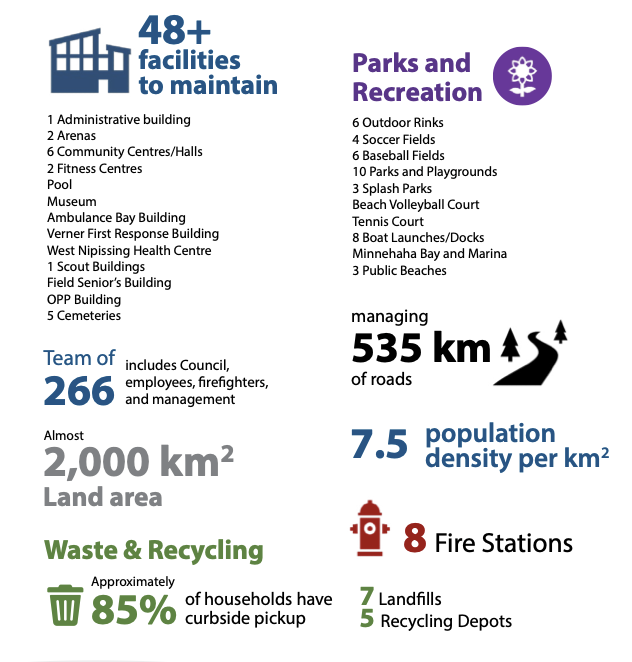
West Nipissing has roughly 14,500 residents spread across almost 2,000 square kilometres. That’s about 7.5 people per square kilometre. Approximately 7,200 households are contributing to the municipal tax base. So while our population is relatively small, the area we have to service is not.
We maintain roughly 535 kilometres of municipal roads, including about 430 kilometres of gravel roads. We also maintain roughly 1,000 kilometres of ditches and 38.5 kilometres of sidewalks. When a grader or snowplow has to travel from one community to another, that’s time, fuel, equipment wear and maintenance. When a road needs work, the cost isn’t just the work itself. There is also the cost of getting the people and equipment there. You need more equipment and more people to provide those services.
Fire protection is another example residents can relate to. We have eight fire stations across the municipality. Each one has to be heated, insured and maintained. Each has specialized equipment and a fire apparatus that needs to be maintained and eventually replaced. When a fire truck leaves the hall, nobody wants to think about the cost of maintaining that truck. They just want it to start, get where it’s going and do its job.
And those are only two services.
West Nipissing has more than 48 municipal facilities and a long list of other assets to operate and maintain — seven landfills, two arenas, six community centres and halls, five cemeteries, a swimming pool, a museum, parks, playgrounds, sports fields, outdoor rinks, boat launches and docks, along with municipal buildings, vehicles and equipment.
Most of us see only one piece of that system at a time. We see our road. Our arena. Our local community centre. The fire hall in our community. But collectively, there is a very large amount of infrastructure to keep operating. And eventually, everything wears out.
A road needs resurfacing. A roof needs replacing. A vehicle needs to be replaced. A fire apparatus reaches the end of its useful life. A building needs a major repair. Those costs don’t disappear because we wish they were lower. They have to be planned for.
This is also why comparing municipalities based only on population doesn’t tell the whole story.
Kenora has a similar population to West Nipissing — roughly 15,000 people. But it covers about 210 square kilometres, compared with almost 2,000 here. Its population is much more concentrated, and it has approximately 335 kilometres of municipal roads compared with our 535.
Same general number of people. Very different amount of infrastructure to maintain. Very different cost to provide services.
That’s the connection back to taxes.
Keeping taxes affordable matters. But so does understanding what those taxes are paying for. A lower percentage doesn’t change the cost of maintaining a road, keeping a fire truck ready, heating a community centre or replacing a piece of equipment when it reaches the end of its life.
Municipal government is about making choices with finite resources and balancing competing priorities. It means understanding the realities of the community, listening to what residents need and making thoughtful decisions about where limited dollars should go.
That is why who we elect matters. We need people around the Council table who understand the realities of our community and can thoughtfully weigh its priorities, its needs and its resources.
If you want to take a deeper look at what goes into delivering municipal services in West Nipissing,
the Municipality’s Budget Handbook is a good place to start.
It explains how the municipal budget works, where the money comes from, what it pays for,
and the range of services and infrastructure the Municipality is responsible for.
It also gives a good picture of just how much there is to maintain across our community.
You can read the Municipal Budget Handbook here:
West Nipissing Municipal Budget Handbook